
Solar Panel Inspection
Airdrie | Cochrane | Okotoks | Chestermere | High River | Crossfield | Black Diamond | Turner Valley | Redwood Meadows | Bragg Creek
Langdon | Didsbury | Water Valley | Irricana | Surrounding communities across the Calgary region
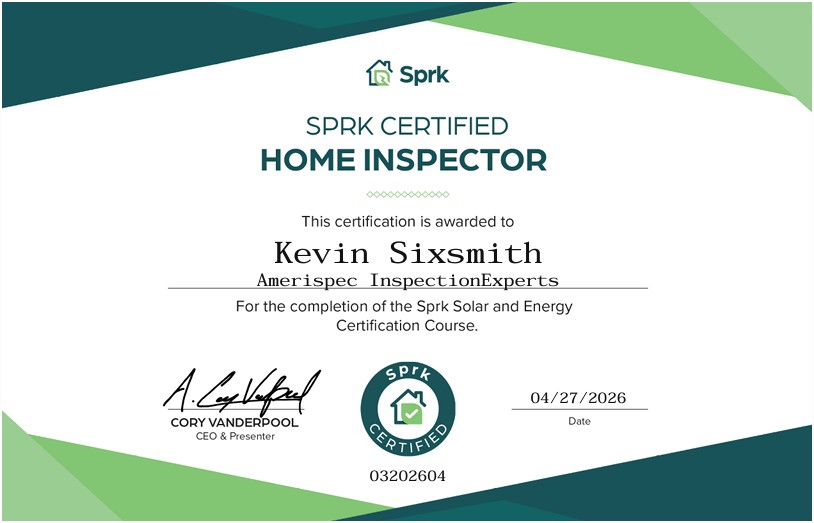
AmeriSpec InspectionExperts is home to one of Calgary's only SPRK Certified Solar Inspectors. Kevin Sixsmith (SPRK Certificate No. 03202604, issued April 27, 2026) completed the Sprk Solar and Energy Certification Course — a rigorous program that trains home inspectors to evaluate solar systems the way they were meant to be evaluated: as a complete, interconnected system, not just a visual check from the ground.
Most home inspectors stop at the roofline. Our certified inspector goes further. We assess all 10 visually identifiable solar problems: unsafe energy connections, missing safety labels, fire code setback violations, improper roof penetrations, loose solar wires, shading from trees or structures, debris buildup, pest activity under panels, unsecured mounts, and broken panel glass. Every inspection is paired with a Sprk Solar Health and Performance Report, giving you a clear picture of your system's condition, safety, and expected lifespan.
Solar panels are one of the most expensive systems on your home. Fewer than 5% of home inspectors are trained to properly evaluate them.
We Inspect to Protect — and that includes your solar investment.
📞 403-257-4820 | 📧 [email protected]
The 10 Solar Problems We're Trained to Find
Unsafe Solar Energy Connections — Breakers installed too close to the main panel, loose wires, unsecured utility meter collars
Missing Solar Labels — Required safety labels on breakers, conduit, and near the utility meter
Fire Code Violations — Panel setbacks from the roof ridge, rake edge, and drip edge
Trees Shading Solar Panels — South, east, and west-facing trees reducing energy output
Loose Solar Wires — Wires hanging, resting on roofing material, or secured with broken zip ties
Improper Roof Penetrations — Lag bolts missing rafters, water intrusion at attachment points
Debris on Solar Panels — Snow, dirt, pine needles, bird droppings reducing light collection
Pest Activity Under Panels — Bird or rodent nests, chewed wiring, droppings
Panels Not Safely Mounted — Loose or missing clamps, panels that move or rattle
Broken Solar Panels — Cracked or shattered glass reducing output of the entire system
Source: Sprk Solar Inspection Standard — the same training framework Kevin Sixsmith completed to earn his SPRK Certification.
Calgary's Climate Is Unique for Solar — Here's What We Look For
Calgary presents a combination of weather and wildlife conditions that no generic solar inspection checklist is built for. The first challenge is hail. Calgary sits within Canada's Hail Alley, and the 2024 hailstorm alone caused over $2.8 billion in damages — making it the second-costliest insured event in Canadian history — and the damage to solar systems is not always visible from the ground. Even without visible cracks, hail can cause microcracks in panel glass that create hotspots and quietly degrade energy output over time. The second challenge is thermal stress from Calgary's famous Chinook winds. Calgary's continental climate produces extreme temperature variations, with winters dropping to –30°C and Chinook events capable of dramatic swings within hours. That repeated expansion and contraction puts pressure on mounting bolts, electrical conduit, and the solder joints inside each panel — stress that builds invisibly over seasons. The third challenge is wildlife. Solar YYC, one of Calgary's established solar installers, recommends a critter guard for nearly every rooftop installation in the city, and for good reason — Calgary and surrounding areas are home to Eastern Grey Squirrels that chew solar wires during nesting periods, in some cases damaging panels and inverters to the point where a full system replacement is required. Alberta Ecotrust, which has funded multiple projects to accelerate solar PV adoption across Calgary through its Climate Innovation Grant Program, recognizes that long-term solar performance in this province depends on more than good installation — it depends on ongoing evaluation in real Alberta conditions. Our SPRK-certified inspection is designed specifically around these three threats, giving Calgary homeowners a professional assessment that reflects what is actually happening to their system — not a checklist written for a climate that looks nothing like ours.
Sources:
Sprk Solar Inspection Standard — the same training framework Kevin Sixsmith completed to earn his SPRK Certification.
2024 hail damage + microcracks → panelupgradeexperts.com (Panel Upgrade Experts, July 2025)
Chinook temperature extremes → xolar.ca (Xolar Calgary)
Solar YYC critter guard recommendation → solaryyc.ca/is-a-solar-critter-guard-necessary
Eastern Grey Squirrel wire damage → rockymountainsolarco.ca
Alberta Ecotrust solar grants → albertaecotrust.com/news/grant-project-shines-light-on-urban-solar
Where We're Seeing the Most Solar in Calgary Right Now
Solar adoption in Calgary is growing across two distinct groups of homeowners, and each group has its own inspection needs. In newer communities across the northwest and southeast, major production builders have been making solar a standard feature since 2024. Mattamy Homes, for example, made solar panels standard on all single-family homes, duplex homes, and rear-lane townhomes across its Alberta division in June 2024, meaning buyers in communities like Ambleton, Glacier Ridge, Seton, and Rangeview are often inheriting systems they never chose and have little documentation for. A post-possession solar inspection confirms the system was commissioned correctly and is producing as expected. In established neighbourhoods, retrofit activity has been driven largely by the City of Calgary's Clean Energy Improvement Program (CEIP), which allows homeowners to finance up to 100% of project costs to a maximum of $50,000, repaid through their property tax bill. Demand for the program has been strong — the City of Calgary reported that every quadrant of the city has participated, with more than $9.3 million in energy-efficient upgrades added to Calgary homes through the initial funding round alone. Calgary's CEIP pre-qualification intake is currently paused after receiving high demand, but systems installed under earlier rounds are now old enough that wiring, inverters, and roof penetrations deserve a professional review. Whether your solar came with your new home or you added it through a retrofit program, AmeriSpec InspectionExperts serves Calgary and over 20 surrounding communities including Cochrane, Airdrie, Chestermere, Okotoks, and High River.
Source:
Mattamy statement → newswire.ca (Mattamy Homes press release, April 2026)
CEIP financing details → calgary.ca/environment/programs/clean-energy-improvement-program
City participation data → livewirecalgary.com (January 21, 2025)
CEIP paused intake → alberta-solar.org/financing/ceip
Our Partnership with Sprk
InspectionExperts is proud to partner with SPRK, a leading Canadian solar diagnostics and performance‑analysis company. This collaboration allows us to deliver a deeper, more accurate understanding of your solar system’s condition — far beyond a basic visual check. Through Sprk’s advanced reporting tools and data‑driven methodology, every Sprk Solar Inspection Report includes:
Independent performance insights backed by industry‑standard testing
Objective evaluation of system health, safety, and installation quality
Clear production expectations based on real‑world data
Transparent findings that help homeowners make confident decisions
A standardized reporting format trusted by buyers, sellers, and insurance providers
By combining our on‑site expertise with SPRK’s analytical platform, you receive a comprehensive, unbiased, and easy‑to‑understand report that reflects the true condition of your solar system.
FAQ related to Solar Panel Inspections
Homeowners often have questions about how solar inspections work, what we look for, and when an inspection is truly necessary. These FAQs give you clear, practical answers so you can understand your system’s condition, safety, and performance with confidence.
What is a SPRK Certified Solar Inspector?
A SPRK Certified Solar Inspector has completed the Sprk Solar and Energy Certification Course, a structured training program that teaches home inspectors how to identify the 10 most common solar safety and performance problems. Kevin Sixsmith of AmeriSpec InspectionExperts holds this certification (No. 03202604), making him one of the few qualified solar inspectors serving Calgary and surrounding communities.
Is a SPRK solar inspection different from a regular home inspection?
Yes. A standard home inspection may note that solar panels are present, but rarely evaluates them in depth. A SPRK-certified inspection specifically assesses panel condition, electrical connections, mounting integrity, roof penetrations, fire code setbacks, shading, pest activity, and debris — and delivers a Sprk Solar Health and Performance Report with the findings.
How much does a solar panel inspection cost in Calgary?
Solar panel inspection pricing depends on system size and whether it is combined with a home inspection or booked as a standalone service. Call us at 403-257-4820 or email [email protected] for a quote specific to your property.
How often should I get my solar panels inspected in Calgary?
Most systems benefit from an inspection every 1–2 years, especially in Calgary where hail, snow load, and freeze–thaw cycles can affect wiring, racking, and roof penetrations. Annual inspections are recommended for older systems or homes in hail‑prone communities.
Can you inspect my solar system if I didn’t install it myself?
Yes. We inspect systems installed by any contractor or builder. Many homeowners book inspections after purchasing a home with existing solar to confirm the system was installed correctly and is performing as expected.
Will the inspection identify safety hazards or fire risks?
Yes. We check for damaged wiring, loose connections, improper grounding, overheated components, and incorrect breaker sizing. These issues can pose electrical or fire risks if left unaddressed.
Do you check the roof condition around the solar panels?
Yes. We assess flashing, penetrations, sealants, and the condition of the roofing materials around the array. Calgary’s weather can cause premature wear, and roof issues are one of the most common findings in solar inspections.
What happens if you find a problem with my solar system?
You’ll receive a clear summary of the issue, photos, and recommendations for next steps. Most repairs require a certified solar installer or electrician, and your report can be shared directly with them for quotes or warranty claims.

Expert Protection Now: Same-Day Reports, NRCan Alerts
Act now: hit the 12-month deadline by booking Same-Day Reports to secure NRCan Protection and unlock CMHC/CEIP refunds right away.

Integrity
Honesty and transparency.

Excellence
Top-notch services.
FOLLOW US


COMPANY
CUSTOMER CARE
Copyright 2026. InspectionExperts. All Rights Reserved.